
SKAI Intelligence Participates in ABB Robotics and NVIDIA's Physical AI White Paper
[Robot Newspaper]
SKAI Intelligence Participates as Main Contributor to ABB Robotics and NVIDIA White Paper on Industrial Physical AI for High-Precision Manufacturing
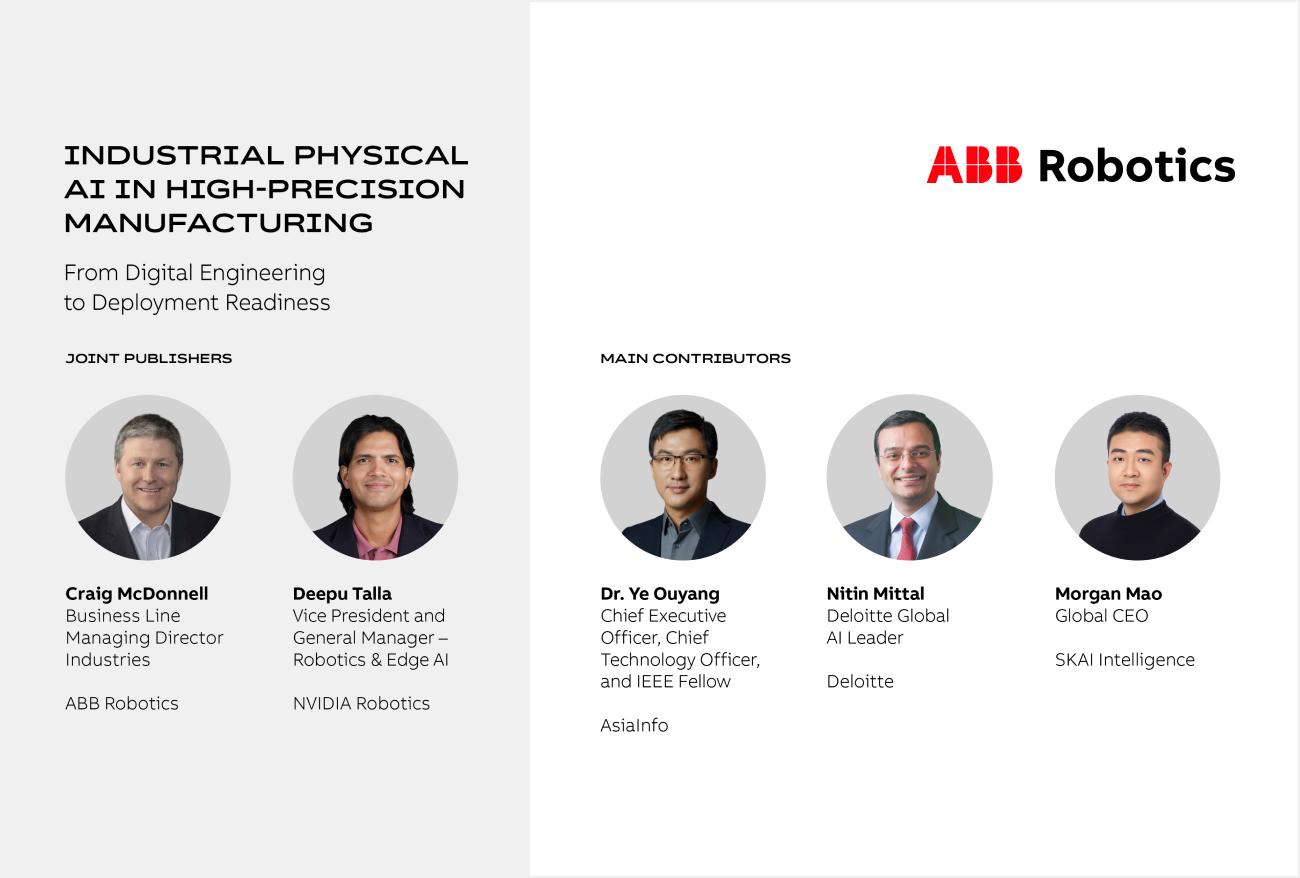
July 20, 2026 — SKAI Intelligence announced today that it has participated as a Main Contributor in the white paper titled "Industrial Physical AI in High-Precision Manufacturing," jointly published by ABB Robotics and NVIDIA.
Alongside Deloitte and AsiaInfo, SKAI Intelligence contributed technical expertise to key sections of the white paper, including industrial digital twins, task-level synthetic data, robot vision datasets, and the Real2Sim2Real engineering loop.
The white paper examines the critical challenges facing manufacturers as the industry transitions toward Physical AI. It argues that successful deployment of Physical AI is determined not by a single AI model or robot alone, but by the ability to integrate robotics systems, AI computing, simulation, data governance, synthetic data, robot vision, and production feedback into a unified engineering framework capable of validation, deployment, and scalable operation.
According to the report, manufacturing is rapidly evolving from traditional fixed automation toward robot vision-based Physical AI. As this transition accelerates, competitive advantage is shifting away from improving the performance of individual AI models and toward developing digital engineering capabilities that enable training, validation, and risk identification before systems are deployed in real production environments.
Accordingly, the white paper expands the primary evaluation metric for Physical AI from Model Accuracy to Deployment Readiness, emphasizing the importance of engineering systems that are prepared for reliable industrial deployment.
Within the framework presented in the white paper:
- ABB Robotics contributes industrial robotics technologies, automation systems, and digital engineering capabilities through its RobotStudio platform.
- NVIDIA provides AI computing infrastructure and simulation capabilities based on NVIDIA Omniverse.
- Deloitte contributes expertise in industrial transformation strategy, ROI assessment, and enterprise-scale implementation methodologies.
- AsiaInfo provides perspectives on enterprise AI platforms and data governance.
SKAI Intelligence's primary contributions focus on industrial digital twins, synthetic data generation, robot vision data construction, and Real2Sim2Real engineering workflows.
The white paper also introduces "validation moved forward" as a key mechanism for bringing robot vision AI from laboratory environments into real-world manufacturing.
In conventional robot vision workflows, risks associated with machine vision, production processes, and system integration are often identified only after mechanical design has been completed, production lines have been installed, or on-site commissioning is already underway. These late-stage discoveries frequently extend deployment schedules and significantly increase validation costs.
By leveraging digital twins, simulation, and synthetic data, many of these risks can instead be evaluated and iteratively refined during the digital engineering stage—well before physical production begins.
Within this methodology, the value of synthetic data lies not simply in generating larger volumes of images. Rather, its greatest strength is the systematic representation of rare events, boundary conditions, and failure modes that are difficult or impossible to capture during the early stages of production.
SKAI Intelligence develops task-level synthetic datasets that accurately model key variables encountered in high-precision manufacturing, including manufacturing tolerances, surface reflections, occlusions, pose variations, and assembly deviations. This enables robot vision AI training and validation data to become traceable, reusable engineering assets throughout the product lifecycle.
The white paper further presents Real2Sim2Real not as a one-time data conversion process, but as a continuous engineering feedback mechanism.
Operational feedback collected from actual production environments is continuously incorporated back into digital assets, enabling subsequent scene reconstruction, synthetic data generation, AI model training, and deployment validation. Through this iterative engineering loop, the digital environment evolves beyond a testing platform into a comprehensive validation layer connecting production lines, AI models, and robotic systems.
Morgan Mao, Global CEO of SKAI Intelligence, stated:
"In the era of Physical AI for high-precision manufacturing, the challenge is not simply making robots move. The real challenge is enabling robots to reliably perceive complex and dynamic production environments, understand operational constraints, and perform consistently under real manufacturing conditions."
He continued:
"SKAI Intelligence's digital twin and synthetic data capabilities are not intended merely to generate more data. Our objective is to bring rare but high-impact failure scenarios forward into the digital engineering stage, allowing training, validation, and deployment readiness to be established through a traceable engineering loop before systems are introduced onto production lines."
Morgan Mao added:
"The significance of this white paper lies in expanding the discussion of Physical AI beyond model performance to a comprehensive system capability encompassing digital engineering, simulation-based validation, data governance, and real-world production feedback. SKAI Intelligence will continue advancing its digital twin and industrial synthetic data technologies to help manufacturers establish scalable processes for the development, validation, and deployment of robot vision AI."
Participation in this white paper also marks another milestone in the strategic collaboration between SKAI Intelligence and ABB Robotics.
In June 2026, the two companies signed a Cooperation Framework Agreement to jointly advance the validation and industrial adoption of Physical AI technologies by integrating ABB Robotics' automation platform with SKAI Intelligence's high-precision synthetic data generation pipeline for manufacturing applications.
The white paper is intended to support manufacturers in developing Physical AI strategies, planning digital proof-of-concept (PoC) projects, evaluating pilot workstations, and preparing for large-scale industrial deployment.
It will be made available through the official ABB Robotics website.
SKAI Intelligence Contributes as Main Contributor to ABB Robotics and NVIDIA White Paper on Industrial Physical AI
Subheadline
- Provides expertise in industrial digital twins, synthetic data, robot vision datasets, and the Real2Sim2Real engineering loop
- White paper proposes Deployment Readiness as the next benchmark for Physical AI in high-precision manufacturing
- Collaboration with ABB Robotics expands to accelerate industrial deployment of Physical AI technologies