
Company Spotlight: SKAI Intelligence, the Synthetic Data Startup Behind the ‘Playbook’ for Physical AI, Backed by NVIDIA and ABB Robotics
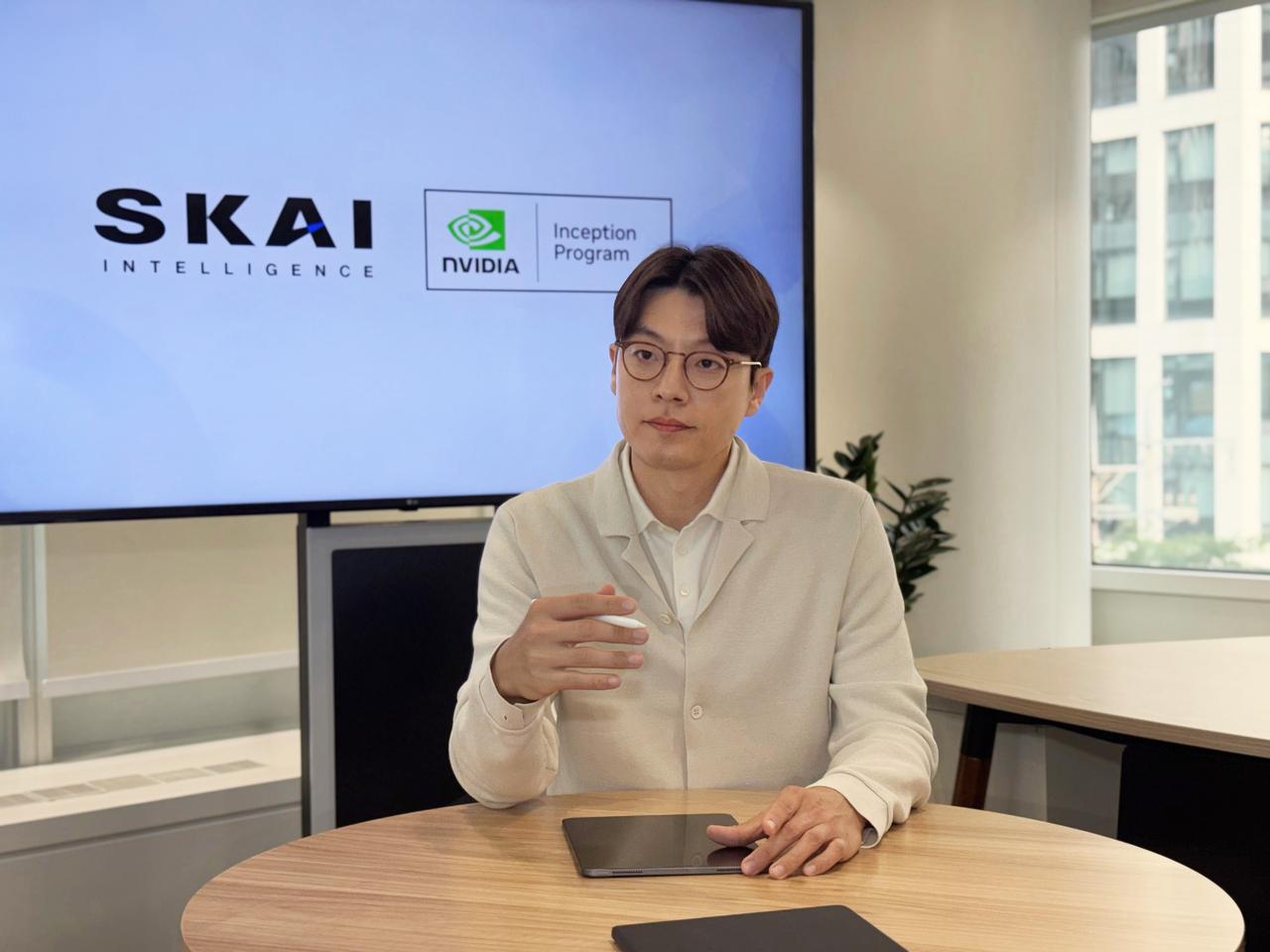
"The robot's real-world experience is the core of physical AI"
AI training by generating virtual data that closely resembles reality
Selected as an NVIDIA Independent Software Vendor Partner
Collaboration with global industrial robot company ABB Robotics
Institutions participating as key contributors to the 'Physical AI White Paper' from both companies
Beyond industrial use to medical fields... "Aiming for the standard of physical AI"
There are so many companies in the world. What kind of company is this? Companies that split, merge, and rebrand new signs keep emerging. Some start new businesses, others close those they've been running for years. We easily deliver dynamic industry stories of companies through on-site reporting and data analysis.
![A robotic arm-based 3D scanning task is being performed to realize real objects as high-precision digital twins. [Provided by Sky Intelligence]](https://wimg.heraldcorp.com/news/cms/2026/07/28/news-p.v1.20260716.631dd318f3914c77ae4bf242c5b5dffe_P1.png)
[Herald Economy = Reporter Bu Aeri] "We have entered a world where robots dance and kick balls, so why haven't laundry robots been commercialized yet? Because I haven't learned enough about the physical world related to laundry."
Robotics technology has advanced remarkably. It has become a world where robots climb stairs, dance, and perform complex movements like humans. However, the simple household chores that humans do in daily life remain challenges that robots have yet to solve. Humans experience the world from birth, but robots do not. Lee Jae-chul, CEO of SKAI Intelligence, said, "Recognizing and handling objects is much more difficult than dancing," adding, "Enabling robots to experience the real world is the core of physical artificial intelligence (AI)."
Recently, the AI industry has rapidly expanded beyond generative AI that generates text and images to 'physical AI' that understands and moves the real world. Physical AI is a technology that enables robots to recognize real spaces and make decisions on their own. It is expected that the scope of use will expand not only in manufacturing but also in logistics, healthcare, and service industries. Jensen Huang, CEO of Nvidia, declared, "The next wave of AI is physical AI," and global big tech companies such as Tesla, Google, DeepMind, and Meta are also pouring massive investments into developing humanoids and industrial robots.
However, no matter how advanced a robot's body and brain are, if it cannot experience reality, it cannot work like a human. This is exactly the point Sky Intelligence has focused on. CEO Lee defined Sky Intelligence as "a company that creates textbooks and workbooks for robots."
CEO Lee said, "Humans are born with bodies, eyes, and brains, but they learn hot and cold things, and learn to walk by falling," adding, "Robots are the same. After body, eyes, and brain, what is needed is experience. We produce the data that creates those experiences," he said.
![Lee Jae-chul, CEO of Sky Intelligence, is interviewing Herald Economy. [Reporter Bu Aeri]](https://wimg.heraldcorp.com/news/cms/2026/07/28/news-p.v1.20260716.a13e792ed3144a2c8193a09475b82160_P1.jpg)
'Synthetic Data' Emerging as a Core Asset in the Physical AI Era
Generative AI has evolved by learning from vast amounts of text and image data. But physical AI is different. For robots to assemble parts in factories, assist with surgeries in hospitals, or do laundry at home, they need to understand the physical properties of the real world.
Even the process of folding a single T-shirt involves countless variables. The material and thickness of the fabric, the degree of stretching, the tension when pulled by hand, shadows under lighting, and even the reflected light detected by the camera all differ. While this is natural for humans, robots require extensive repetitive learning.
For this reason, in the era of physical AI, 'synthetic data' is emerging as a new core asset. Instead of collecting actual data one by one, it generates virtual data that mimics reality in a digital twin environment and trains the AI.
Sky Intelligence realizes a variety of scenarios that robots can experience within NVIDIA's 'Omniverse'-based environment. Omnibus is a digital twin platform that realizes real factories or work environments in virtual spaces. Sky Intelligence generates synthetic data in this space that enables robots to learn from the physical world, helping them operate like humans in real environments.
CEO Lee emphasized, "Just as you study with textbooks and workbooks and make error notes at school, robots must first gain diverse experiences." He continued, "Once you learn the correct answer, even a slightly different situation in the field will stop you," and explained, "The textbook containing all the transformation problems is exactly the synthetic data created by Sky Intelligence."
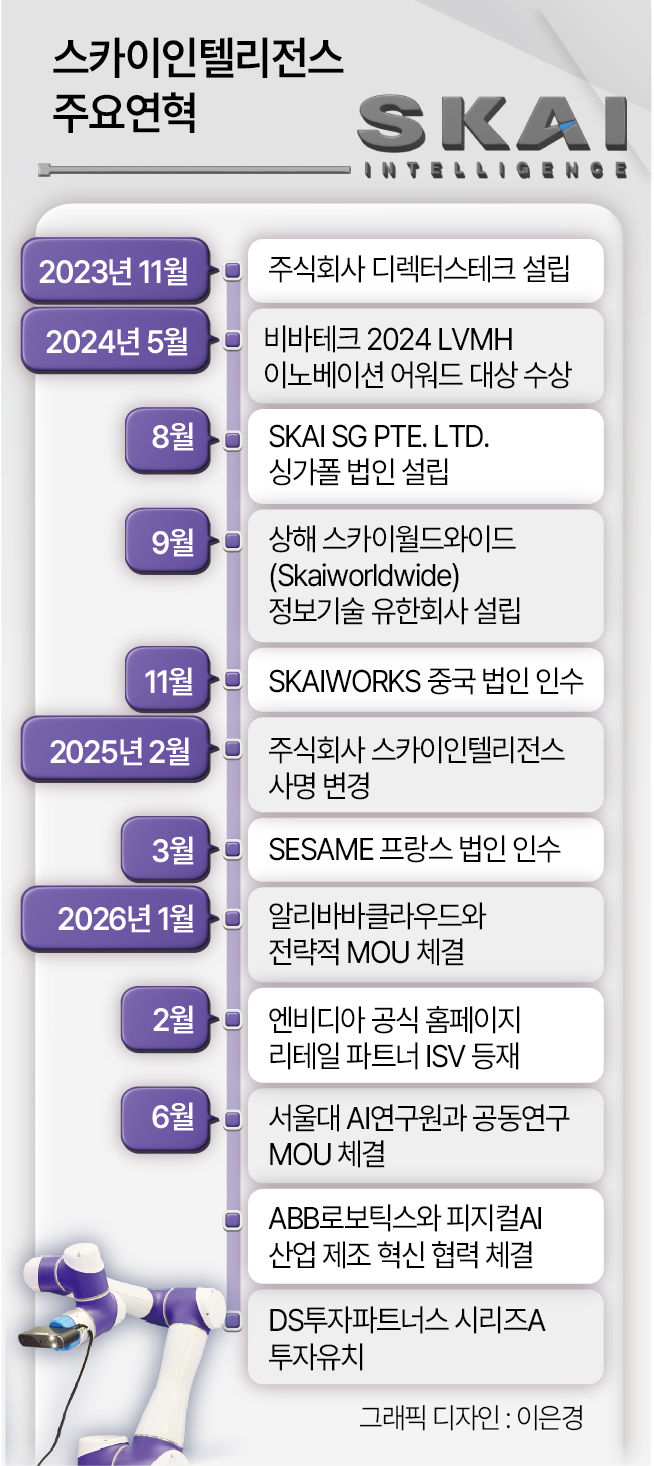
Riding the wave of the NVIDIA ecosystem, they also join hands with ABB Robotics
In the physical AI ecosystem, it is difficult for one company to handle all technologies. Some companies create robot bodies, some vision AI companies recognize objects through cameras, and others develop foundation models that act as brains. NVIDIA provides the omniverse platform and 'Isaac Sim,' but does not create all the data needed for actual training directly.
Sky Intelligence enables robots to pre-learn by detecting numerous cases of product scratches, shines, lighting, and camera noise in a digital twin environment. The goal is to enable responses to exceptional situations that may arise in industrial settings.
Based on this technological strength, Sky Intelligence was selected as an independent software vendor (ISV) partner by NVIDIA. It is also collaborating with global industrial robotics company ABB Robotics. Recently, it participated as a key contributor to the 'Physical AI White Paper' produced by NVIDIA and ABB Robotics. The white paper will cover the technical directions and industrial application plans for physical AI used in high-precision manufacturing.
Industrial robots are identified as the primary application area for synthetic data. Although smart factories have been largely automated today, many reveal limitations in the final stage. This is due to a 'domain gap,' where even minor scratches, lighting changes, or small errors in product positioning can cause the robot to stop working. This phenomenon is a phenomenon where the robot's recognition performance declines due to differences between the training environment and the actual field.
![The screen on the left compares real industrial processes and components, while the right side shows a high-precision digital twin-based simulation environment. [Provided by Sky Intelligence]](https://wimg.heraldcorp.com/news/cms/2026/07/28/news-p.v1.20260716.bc17ef7e5bb144f68e88765cf6329de6_P1.jpg)
Sky Intelligence's strength lies in its technology that integrates real-world industrial measurement data with computer graphics (CG) into a single data system. In actual factories, the camera's perceived aperture value, exposure, light intensity, reflectance, and other metrics are recorded as quantified measurement data. In contrast, CG in virtual environments uses a different language and representation system. Due to the lack of unified standards connecting real and virtual data, the two data types have often been used separately.
CEO Lee explained, "The data measured in reality and the language used by CG are different," adding, "We are developing an engine that converts and connects both types of data based on the same criteria."
The company plans to automate this process by building a PaaS platform by the end of the year. When a manufacturing company inputs a design drawing (CAD) file, AI automatically generates hundreds of thousands~millions of 3D synthetic data pieces based on it, creating both normal and error cases so that the robot learns from various situations.
In June, Sky Intelligence signed a strategic cooperation framework agreement with ABB Robotics. ABB Robotics is a global automation company supplying industrial and collaborative robots, autonomous mobile robots (AMRs), controllers, and robot software. The robotics division's revenue reaches $2.3 billion.
The two companies are working to build physical AI infrastructure and verification systems based on ultra-precise synthetic data technology. This method trains AI models using synthetic data generated by Sky Intelligence, then verifies their performance in ABB's robot work environment. They plan to expand their scope of cooperation through future technology exchanges, demonstrations, product collaborations, and customer projects.
"AI is creating a world where we learn"
Recently, the competitive landscape of the AI industry has been changing rapidly. In the early days of generative AI, the key was who developed superior large language models (LLMs), but going forward, what the model learns and accumulates will likely determine its competitiveness.
CEO Lee said, "Big tech already has excellent models and computing infrastructure," adding, "The key is not the AI models themselves, but the experience and data that help AI understand reality."
The ultimate goal of Sky Intelligence is to establish an industry standard in the field of synthetic data. Currently, the physical AI market is at the starting line of full-scale growth, and each company has its own unique approach to generating and utilizing data.
CEO Lee said, "Just as every language has its own dictionary, AI needs standardized data, but there is still no unified standard across the industry," adding, "Our goal is to create data standards that can be used in industrial settings together with global leaders like NVIDIA and ABB Robotics, and to establish them as the standard for the physical AI ecosystem."
He continued, "The basic principle of creating synthetic data can be applied not only to industrial robots but also to various fields such as medical robots," and added, "First, we want to prove our competitiveness in the field of industrial robots and then expand into areas that humanity needs to address, such as healthcare."
Reporter Bu Aeri boo@heraldcorp.com