
“Robots That Think Like Humans”… Governments Also Step Up Efforts on ‘Synthetic Data’
[JTBC]
[Anchor]
Jensen Huang, CEO of NVIDIA, who recently visited Korea, said that the next wave after AI will be Physical AI. Ultimately, the success of Physical AI will depend on how quickly robots can think and act like humans in industrial settings. Recently, the government and the private sector have joined forces to develop “synthetic data” that will enable robots to work immediately upon being deployed in the field.
[Reporter]
In the field of Physical AI, there is something attracting even more attention than AI technologies capable of sophisticated reasoning.
It is data that allows robots to learn in advance about the wide range of situations that can occur in real-world industrial environments.
In particular, when robots are trained in advance using “synthetic data” generated through various simulations of production environments, they can perform like skilled workers even when they are deployed to a real-world site for the first time.
Bae Kyung-hoon / Deputy Prime Minister and Minister of Science and ICT (July 20):
“If we consider real-world data to account for 2, the amount of synthetic data we need is around 8. I have continued to emphasize that we need to establish a system that allows us to secure this synthetic data quickly.”
Synthetic data, often described as a textbook for robots, is far more efficient than collecting real-world data in terms of both time and cost.
Lee Jae-chul / CEO of SKAI Intelligence:
“It's like going to a driving school. You may score 100 points in a virtual environment, but when you actually drive on the road, it may rain or snow, and various unexpected situations can arise. We use synthetic data to give robots experience of the physical world and teach them how to respond.”
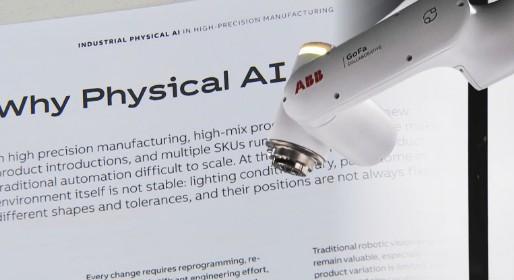
Recently, the company also published a Physical AI white paper with NVIDIA and ABB Robotics based on its synthetic data development capabilities.
Lee Jae-chul / CEO of SKAI Intelligence:
“The goal is for robots to solve problems like humans even when unexpected variables arise. It is about giving robots problem-solving capabilities and enabling them to move like humans. In other words, no matter what variable they encounter, they can respond like a human. That is really the key.”
Going forward, learning through synthetic data is expected to expand beyond industrial robots to applications such as medical robots and household assistant robots.
According to global market research firms, the Physical AI market is projected to grow explosively at an average annual rate of more than 47% through 2032.
[Watch the YouTube Video Again]
[Videographer: Jung Sang-won / Video Editor: Lim In-soo]
Reporter: Kim Do-hoon (kim.dohoon1@jtbc.co.kr)