
KAIST, DAIM Research, and SKAI Intelligence to Jointly Develop AI for Autonomous Manufacturing
[EDAILY]
Combining Synthetic Data, Digital Twin, and Robot Orchestration Technologies
Expanding Cooperation from Joint Research and On-Site Validation to Talent Development and Market Development
[Edaily, Reporter Shin Young-bin] KAIST, SKAI Intelligence, and DAIM Research are joining forces to develop and validate physical artificial intelligence (AI) technologies for manufacturing environments. By combining their respective capabilities—from research and synthetic data to integrated robot control and digital twins—they aim to commercialize autonomous manufacturing.
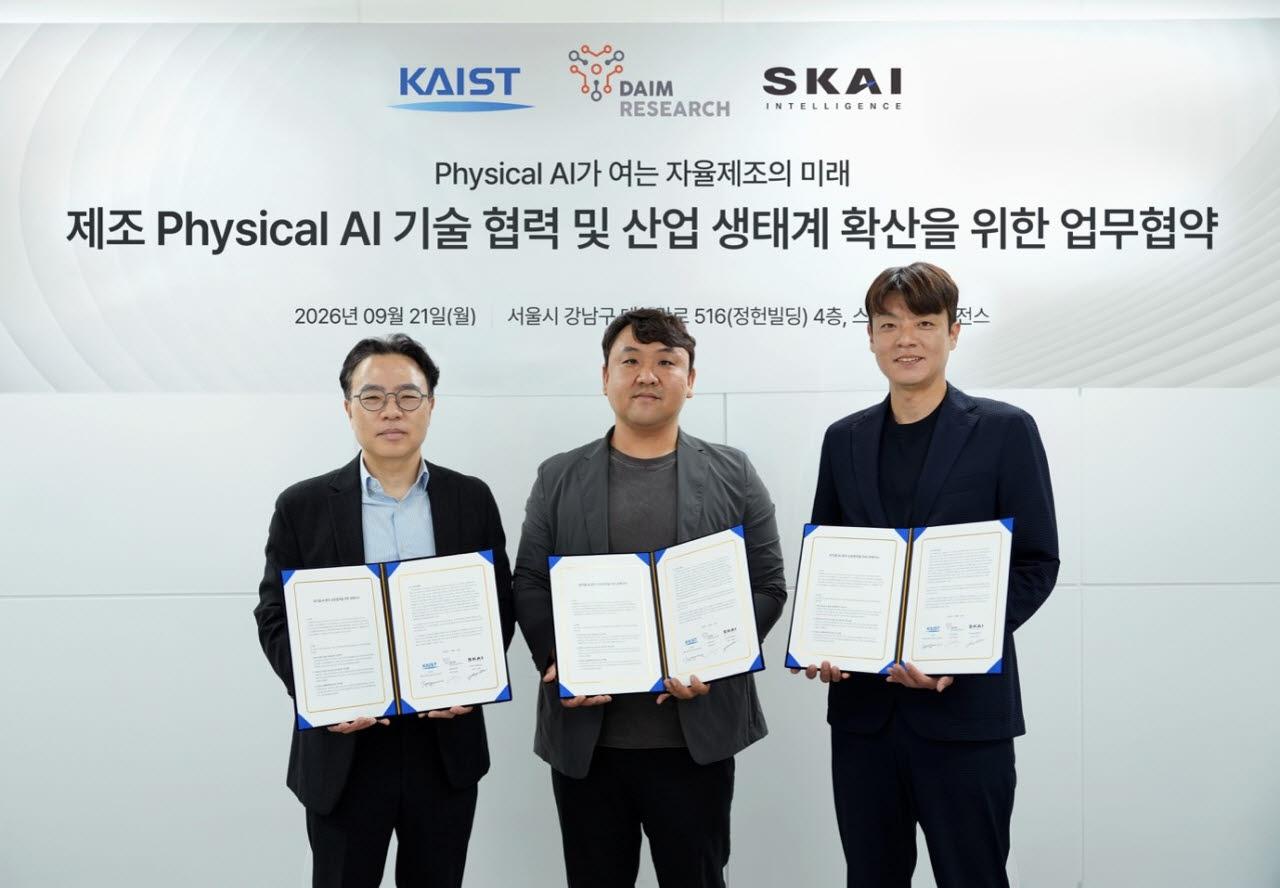
DAIM Research announced that on the 21st, it signed a tripartite memorandum of understanding (MOU) with SKAI Intelligence and the KAIST Institute for Manufacturing Physical AI to collaborate on physical AI technologies and expand the industrial ecosystem.
With the goal of advancing AI transformation in manufacturing, the three organizations will identify opportunities for joint research, business initiatives, and demonstration projects. Their cooperation will also encompass specialist training, technical exchanges, and joint market development.
The KAIST Institute for Manufacturing Physical AI will lead foundational research and core technology development in AI, robotics, and manufacturing systems. SKAI Intelligence will provide technologies for training and validating AI in manufacturing environments, drawing on its synthetic data capabilities. The company has conducted joint proof-of-concept (PoC) projects and pursued strategic cooperation with ABB Robotics.
DAIM Research will contribute its integrated robot control and orchestration capabilities, along with digital twin-based simulation technologies developed through its work in manufacturing and logistics environments. The company is developing autonomous manufacturing technologies that connect different robots and equipment, optimize routes, task allocation, and scheduling, and enable an entire factory to operate as a unified system.
By combining these capabilities, the three organizations will pursue joint research spanning equipment and logistics, individual robots, and robot fleet operations. They also plan to identify demonstration projects to validate the technologies in real manufacturing environments.
They will also collaborate on training specialists in physical AI, digital twins, synthetic data, robotics, and autonomous manufacturing. Joint programs will include training, seminars, technical exchanges, and activities linked to demonstration projects for companies and industry professionals.
The cooperation will also extend to overseas markets. Through domestic and international conferences, forums, demonstrations, site tours, and business matching, the organizations plan to connect their academic and industry partners and customer networks to identify new business opportunities.
“For manufacturing physical AI to create real industrial value, we must go beyond the performance of individual AI systems or robots and ensure that diverse robots, equipment, and systems are connected in a seamless workflow and operated intelligently,” said Hwang Il-hoe, Chief Technology Officer (CTO) of DAIM Research. “We will validate each company’s technological capabilities in real manufacturing environments and develop use cases that pave the way for autonomous manufacturing.”
“Physical AI cannot be fully realized through laboratory technologies alone; it must be validated and advanced by addressing the complex challenges of real manufacturing environments,” said Jang Young-jae, Director of the KAIST Institute for Manufacturing Physical AI. “We will establish a virtuous cycle in which joint research outcomes lead to field demonstrations and broader industrial adoption.”